Orc Incremental Totems
A source-bounded Totem guide covering verified historical names, card drafting, passive army-wide bonuses, stacking evidence, and five unnamed version 1.0 additions.
- Published
- Updated
- Last checked
Quick facts
- System
- Totems are drafted as cards and provide passive bonuses that can change whole-army performance.
- Amber Bear
- Demo v0.09 explicitly identifies Amber Bear as one half of a Totem combination with Ancient Idol. Boundary: Demo v0.09.
- Ancient Idol
- Demo v0.09 explicitly identifies Ancient Idol as one half of a Totem combination with Amber Bear. Boundary: Demo v0.09.
- Amber Drake
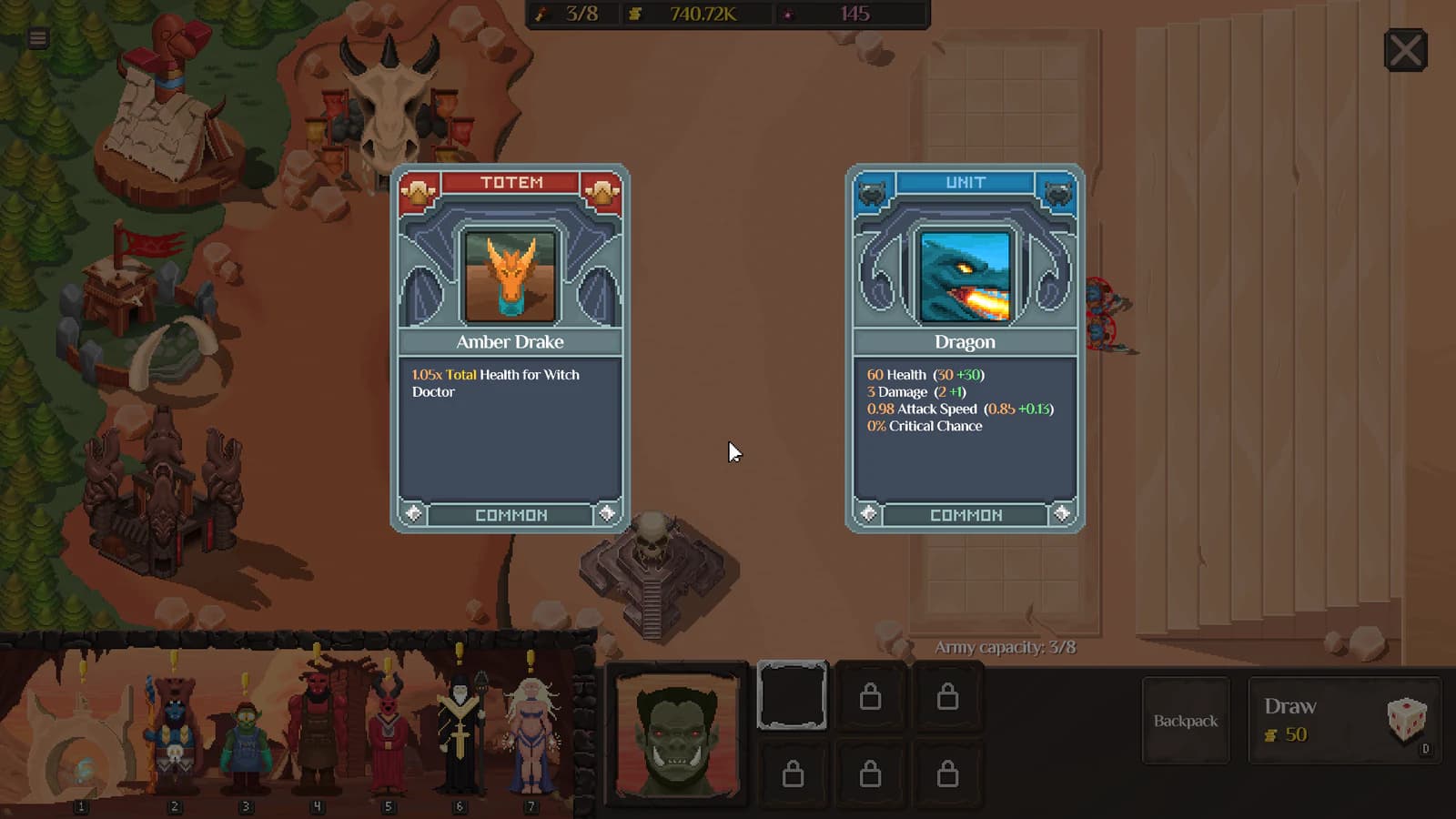
- The April 2026 official press-kit card labels Amber Drake as a Common Totem with 1.05x Total Health for Witch Doctor. Boundary: the April 2026 promotional screenshot.
- Planned scope
- Five new Totems are planned to open up new unit synergies and army-building options.
- Evidence check
- 2026-08-28
Read the source boundary first
This guide separates four kinds of evidence that answer different questions. The current official store describes the place Totems occupy in a run. A historical Demo note records named interactions and an older stacking statement. The April press archive preserves a single pictured card. The release announcement describes future scope without publishing its missing details.
Those sources cannot be merged into one timeless rule set. A store description can define a broad system without giving its formula. A patch note can name an interaction from one Demo build without fixing that behavior for release. A promotional screenshot can preserve visible text without proving that the same value survived later balancing. The registry-backed sections above and below keep each claim attached to its own boundary.
The hero is useful for the same limited reason. It shows a card-draft screen with one card labeled as a Totem. It does not reveal a complete draw algorithm, final rarity distribution, or current effect table. Treat the frame as a dated interface record.
Three verified historical names
The roster table contains only names that an official source explicitly classifies as Totems. That is a narrower rule than collecting every noun near a Totem-related changelog entry.
Amber Bear and Ancient Idol appear in one Demo v0.09 combination context. The sentence establishes that both names belong to a Totem interaction in that historical build. It does not publish either general effect. It also does not explain the operation used when the pair is present.
Amber Drake comes from the April 2026 promotional screenshot. The registry records the literal card observation and labels it historical. This page does not repeat the pictured number as advice because a pre-release promotional value is not a released-build recommendation. If the card appears in a later build, capture that later card on its own terms.
No other name enters this allowlist from a filename, character portrait, forum post, or nearby changelog bullet. The threshold is explicit official classification.
| Evidence type | Safe conclusion | Conclusion it cannot support |
|---|---|---|
| Current store description | Totems have a defined place in drafting and army planning | Exact values, draw rates, or final balance |
| Named Demo patch sentence | The named pair had an interaction context in that build | A general effect or stacking formula |
| Promotional screenshot | The pictured card and visible text existed in that dated frame | Current rarity, current effect, or release balance |
| Release announcement | The announced scope contains additional Totems | Their unpublished names or effects |
Five additions remain unnamed
The version 1.0 announcement provides a count and a broad design intention. It does not provide five names, five card texts, or a final distribution across rarities. An empty field is the accurate result.
Do not map the five slots to older promotional characters. Do not treat a historical portrait as a card. And do not turn a theme, color, or vendor image into a name. The release-scope panel will remain incomplete until the developer publishes enough information to fill it.
This also limits internal links. The site has no individual Totem pages because the available evidence would produce thin pages built from guesses. Use the Totem stacking evidence guide for the historical rule boundary, or the cards and drafting guide for a controlled way to record offered choices.
Judge a card by the current bottleneck
A future Totem choice should begin with a diagnosed problem, not with an inherited ranking. Record what prevents the army from advancing: the frontline collapses, the important target remains unreachable, damage arrives too late, or the run lacks enough economy for the next test. Then read the current card text and ask whether it addresses that observed problem.
This is a decision framework, not a list of preferred names:
- Write down the build shown by the game.
- Capture every offered card before choosing.
- Record the current army and arrangement.
- State the failure symptom in one sentence.
- Choose one card and leave other variables unchanged.
- Replay the same encounter when practical.
- Record what changed and what did not.
The formation diagnosis guide helps when position changes at the same time as the card choice. The build comparison worksheet is a better home when progression purchases, formation, and drafting all changed together.
Build a post-release record
A post-release record needs enough context for another player to repeat it. One row per observation is easier to audit than a paragraph written from memory.
| Field | What to record |
|---|---|
| Build | Exact version or dated release label |
| Card | Name and full visible wording |
| Offer | Other cards shown in the same draw |
| Army before | Units, arrangement, and relevant state |
| Choice order | When this copy was taken relative to earlier copies |
| Encounter | Reproducible battle or milestone |
| Result | One visible outcome measured the same way |
| Repeat | Number of comparable observations |
| Open question | Another explanation not yet separated |
If the card text changes after a patch, preserve the old row with its old build. Editing the old record to match a new tooltip destroys the evidence needed to understand the change.
Common source mistakes
The most common mistake is combining sources that describe different moments. A screenshot can look precise because it contains a number, while a prose announcement can look vague. Precision does not make the screenshot current. Date and build still control the claim.
Another mistake is reading a bug fix as a full mechanic definition. A fix can establish that two named things interacted in a specific case. It does not automatically disclose their normal effects, acquisition rules, order behavior, or the equation behind the result.
A third mistake is treating absence as hidden knowledge. The five announced additions remain unnamed in the checked material. Inventing placeholders or borrowing names from another game would make later correction harder and would break the source boundary.
Where to go next
Use Totem stacking evidence when the question involves copies or special tooltip language. Use the spell hub when an active cast is a better response to a battle symptom than another passive card. Use the beginner guide if you first need the larger loop of observing a wall, changing one variable, and checking the result.
The useful rule is simple: preserve what the source proves, label its date and build, and leave every other field open for a later official statement or controlled observation.
Official sourceVerified Totem records
| Totem | Verified statement | Boundary | Checked |
|---|---|---|---|
| Amber Bear | Demo v0.09 explicitly identifies Amber Bear as one half of a Totem combination with Ancient Idol. | Demo v0.09 | |
| Ancient Idol | Demo v0.09 explicitly identifies Ancient Idol as one half of a Totem combination with Amber Bear. | Demo v0.09 | |
| Amber Drake | The April 2026 official press-kit card labels Amber Drake as a Common Totem with 1.05x Total Health for Witch Doctor. | the April 2026 promotional screenshot |
- Name
- Five new Totems
- Boundary
- version 1.0
- Verified statement
- Five new Totems are planned to open up new unit synergies and army-building options.
- Checked
- Still unknown
- five Totem names, five Totem effects, final version 1.0 balance
Frequently asked questions
- What does official material confirm about Totems?
- Totems are drafted as cards and provide passive bonuses that can change whole-army performance. Five new Totems are planned to open up new unit synergies and army-building options. The five names and effects remain not announced, checked 2026-08-28.
- Which Totem names are explicitly verified?
- Amber Bear: Demo v0.09 explicitly identifies Amber Bear as one half of a Totem combination with Ancient Idol. Ancient Idol: Demo v0.09 explicitly identifies Ancient Idol as one half of a Totem combination with Amber Bear. Amber Drake: The April 2026 official press-kit card labels Amber Drake as a Common Totem with 1.05x Total Health for Witch Doctor. Each statement remains limited to its recorded source and build boundary.
- Can an old promotional card establish current balance?
- No. A dated card can document exactly what its frame shows, but it cannot establish a released build's rarity, effect, or balance. Recheck the corresponding card in the named build before carrying any pictured value forward.
- How should a new Totem observation be recorded?
- Write down the build, card name, displayed wording, army before the pick, army after the pick, and one repeatable result. Keep the screenshot observation separate from any explanation of how the mechanic works.
Source ledger
- Orc Incremental official Steam store page
steam-store ·
- Demo Update v0.09
steam-announcement ·
- Orc Incremental press kit — Screenshots/03.png
press-kit ·
- We have a release date!
steam-announcement ·