Orc Incremental Best Formations
Why no universal version 1.0 formation is verified, plus controlled experiments, comparison criteria, a recording template, and failure checks.
- Published
- Updated
- Last checked
Quick facts
- Current answer
- No universal version 1.0 formation is verified.
- Comparison unit
- One position or one army role per test.
- Fixed conditions
- Build, encounter, progression state, and measurement.
- Minimum record
- Baseline, candidate, repetitions, result, and limits.
- Patch rule
- Retest before carrying a result into a changed build.
Why there is no universal formation here
The official Steam description verifies strategic arrangement and automated combat. The version 1.0 announcement verifies four broad allied roles. Neither source publishes a test set that compares arrangements across encounters, progression states, armies, and released builds.
Calling one arrangement universal would hide those missing conditions. A setup that answers an exposed front line may fail when target access is the real bottleneck. A setup that reaches one protected enemy may trade away the survival needed elsewhere.
This page treats "best" as a question that needs a scope. The answer may eventually be useful for one encounter, build, army, or progression state. The current evidence does not support a single arrangement for all of them.
Start with the bottleneck
Before drawing a candidate formation, identify the first repeatable failure:
- an ally is removed before performing its role;
- the blocking target is never reached;
- a useful action arrives after the result is decided;
- the army survives but cannot finish;
- a control or siege action reaches an unexpected target;
- the formation clears the encounter but at an inconsistent rate.
Use the formation diagnosis guide when that first failure is unclear. It separates exposure, access, timing, and outcome without assigning a hidden rule.
A candidate should answer one stated bottleneck. If it changes several roles and positions, it may win, but it will not teach which change answered the problem.
Define a fair comparison
A fair comparison holds these conditions constant:
- exact game build;
- encounter or reproducible battle state;
- progression and relevant purchases;
- drafted army, unless the army choice is the single test variable;
- outcome measure;
- number of comparable attempts.
Then change one arrangement detail. Record both candidates with the same detail. If the interface does not permit an exact replay, state that limitation instead of presenting the attempts as identical.
The official unit roster can help name the role changed. It does not tell you a required position.
Recording template
Copy one row for the baseline and one for each candidate:
| Field | Baseline | Candidate |
|---|---|---|
| Build | exact label | same label |
| Encounter | named or reproducible state | same state |
| Progression | relevant choices and purchases | unchanged |
| Army | full list | unchanged unless tested |
| Arrangement | clear position record | one stated change |
| Bottleneck | first repeatable failure | same question |
| Outcome | visible measure | same measure |
| Attempts | count | matching count |
| Variation | range of observed results | range of observed results |
| Open limit | uncontrolled condition | uncontrolled condition |
Do not omit a failed candidate. Negative results prevent another player from repeating a plausible but unhelpful change and reveal where the original explanation was weak.
Choose a stable outcome measure
Use something the game displays reliably. Depending on the question, that may be encounter completion, first ally lost, blocking target reached, or a visible event sequence. Avoid combining unrelated measures into a private score unless the calculation and purpose are stated.
If one candidate completes the encounter more often while another keeps a unit active longer, neither is automatically superior. Return to the stated bottleneck and decide which measure answers it. Preserve the other observation for a different question.
Test role changes without ranking units
The four announced roles suggest controlled comparisons:
- Assassin reference raises questions about stealth, critical events, exposure, and access.
- Troll reference raises separate survival and reflection questions.
- Warg Raider raises target, pull, and area-effect questions.
- Juggernaut reference raises siege target and explosive-effect questions.
A role can answer a local bottleneck without becoming the top unit overall. If the army change is the test variable, preserve the arrangement as closely as possible and state any position difference that the interface forces.
Read failure cases
Candidate wins once
Repeat it. A single win may be timing variation or a changed condition you did not record.
Candidate survives longer but still loses
Check whether survival was the bottleneck. If target access or damage delivery remains unchanged, the test may have improved the wrong measure.
Candidate changes the selected target
Record the visible sequence, not a target formula. Repeat with the same encounter and list other conditions that might explain the selection.
Candidate cannot be replayed exactly
Label the comparison observational. Keep the conditions you can record and avoid precise causal wording.
Several purchases changed too
Treat the run as a new baseline. Use the build worksheet to separate army, arrangement, and progression choices next time.
Decide when a recommendation is ready
A narrow recommendation is ready when repeated results answer the stated bottleneck, the build and conditions are visible, and another player could repeat the setup. The wording should retain that scope.
For example, describe the encounter and recorded improvement instead of saying the arrangement always works. State the number of comparable attempts. Name any condition that was not controlled. Link the unit records that define the official roles.
The tier evidence page uses a stricter comparison gate for relative unit placement. A formation result does not automatically satisfy it because arrangement and unit value are intertwined.
Recheck after release and patches
As of August 28, 2026, version 1.0 was announced but not available in the checked Steam state. Initial released-build results must carry their exact version. If combat behavior changes, preserve the earlier record and repeat the baseline.
Do not merge Demo observations into version 1.0 rows. A dated older record may explain why a guide once recommended something, but it cannot substitute for the released build.
Media boundary
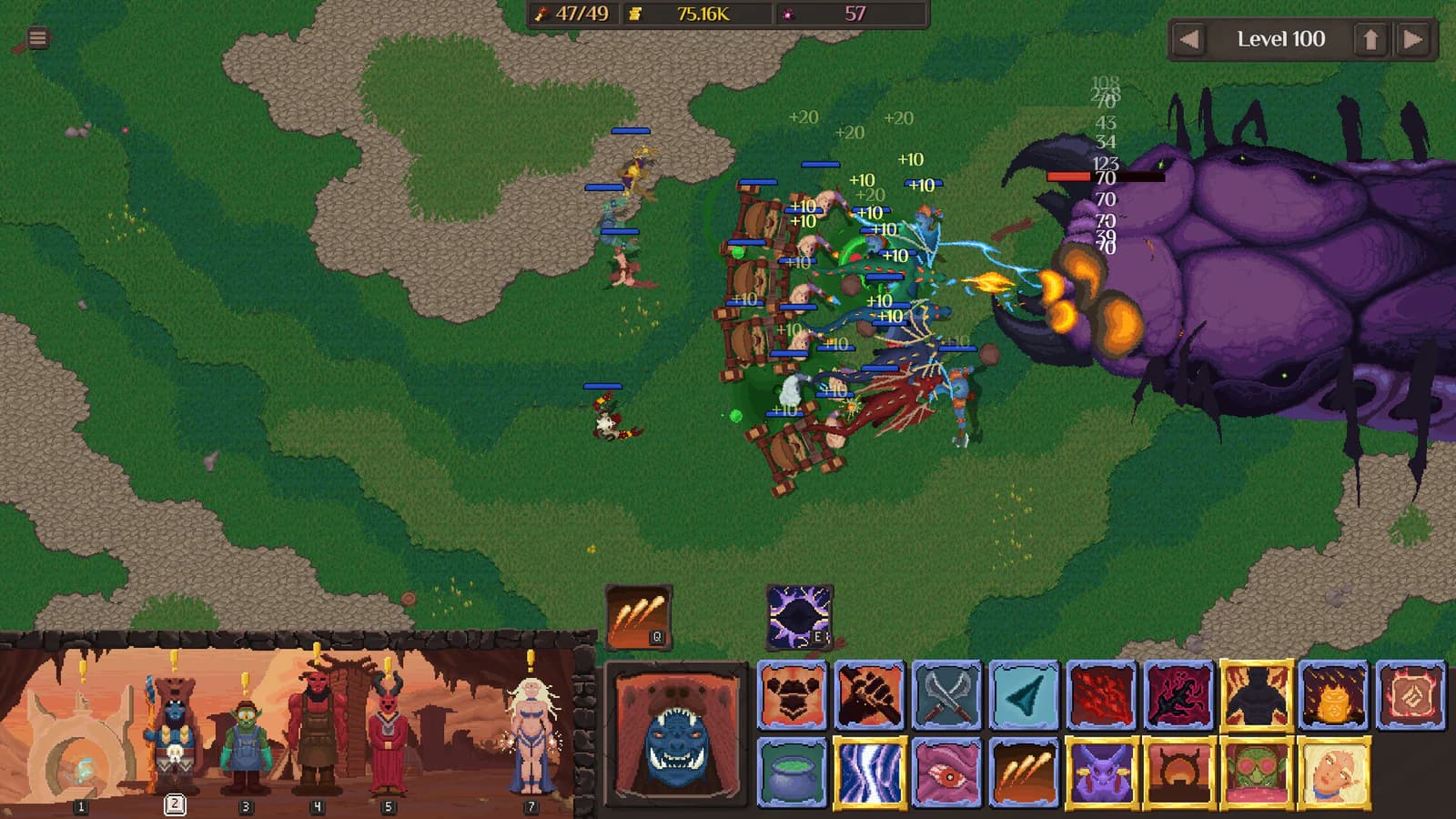
The hero shows an official promotional battle against a large purple opponent. It illustrates an army in combat. It does not prove that the pictured arrangement is recommended, that every figure is an announced unit, or that the frame represents final balance.
Use media to orient the reader, then use named-build observations for formation claims. Composition is not a strategy table.
Publish the limit beside the result
Every useful comparison has a limit: one encounter, one progression state, incomplete replay control, or a small set of attempts. Put that limit beside the result rather than burying it.
This makes the guide durable. A later test can extend the scope, challenge the result, or identify a patch difference without pretending the earlier record covered more than it did.
Official sourceFrequently asked questions
- Is one universal formation verified?
- No. The checked sources do not provide comparable version 1.0 tests across encounters and progression states. This page supplies a method for comparison, not a winning arrangement.
- What belongs in a formation comparison?
- Keep the build, encounter, army, purchases, and number of attempts visible. Change one arrangement detail and record the same outcome measures for both cases.
- When can a recommendation be published?
- Publish a narrow recommendation only when repeated results support it, the build is named, and the tested conditions are stated. Retest after a patch that could affect combat.
Source ledger
- Orc Incremental official Steam store data
steam-store ·
- We have a release date!
steam-announcement ·